Hermes Is Taking Over
“The best role for humans is to set goals while the AI agents figure out how to achieve them.”
The working assumption in the early days of AI was that the titans would maintain an insurmountable lead due to the extraordinary amounts of capital, compute, and distribution required to succeed.
Yet, in typical tech capitalist fashion, companies and communities aggressively built. We have seen LangChain, OpenClaw, Moltbook, Cursor, and others grow to massive scale, either succeeding independently or ultimately being acquired. We believe next on that list is Nous Research.
Nous, which launched as a volunteer open-source collective with ex-Stability AI engineers, iterated and pivoted for years before finally finding pmf with Hermes.
Hermes has become one of the most widely used open-source agent frameworks in the world, powering workflows used by thousands of developers, researchers, and systems globally.
In our view, Hermes has a chance to become one of the most important AI projects in the world.
This report examines the rise of Nous Research, the emergence of Hermes, its rapid adoption, why it matters, and where we go from here.
The Rise of Nous

Nous Research what OpenAI was supposed to be
Nous has a unique origin story.
Nous began as an internet-native research collective founded by former Stability AI engineers. Alongside the core team, researchers, developers, and contributors were drawn to a shared belief that advanced AI should not be controlled by a handful of companies.
While much of the industry focused on building closed systems, Nous focused on creating open-source alternatives.
For years, Nous operated largely under the radar. The team released models, experimented with training techniques, built infrastructure, cultivated a niche community of developers, all while it developed a unique and recognizable brand.
What looked like slow progress from the outside was actually years of compounding. While many projects chased short-term attention, Nous spent years building the models, infrastructure, and community that would eventually power Hermes.
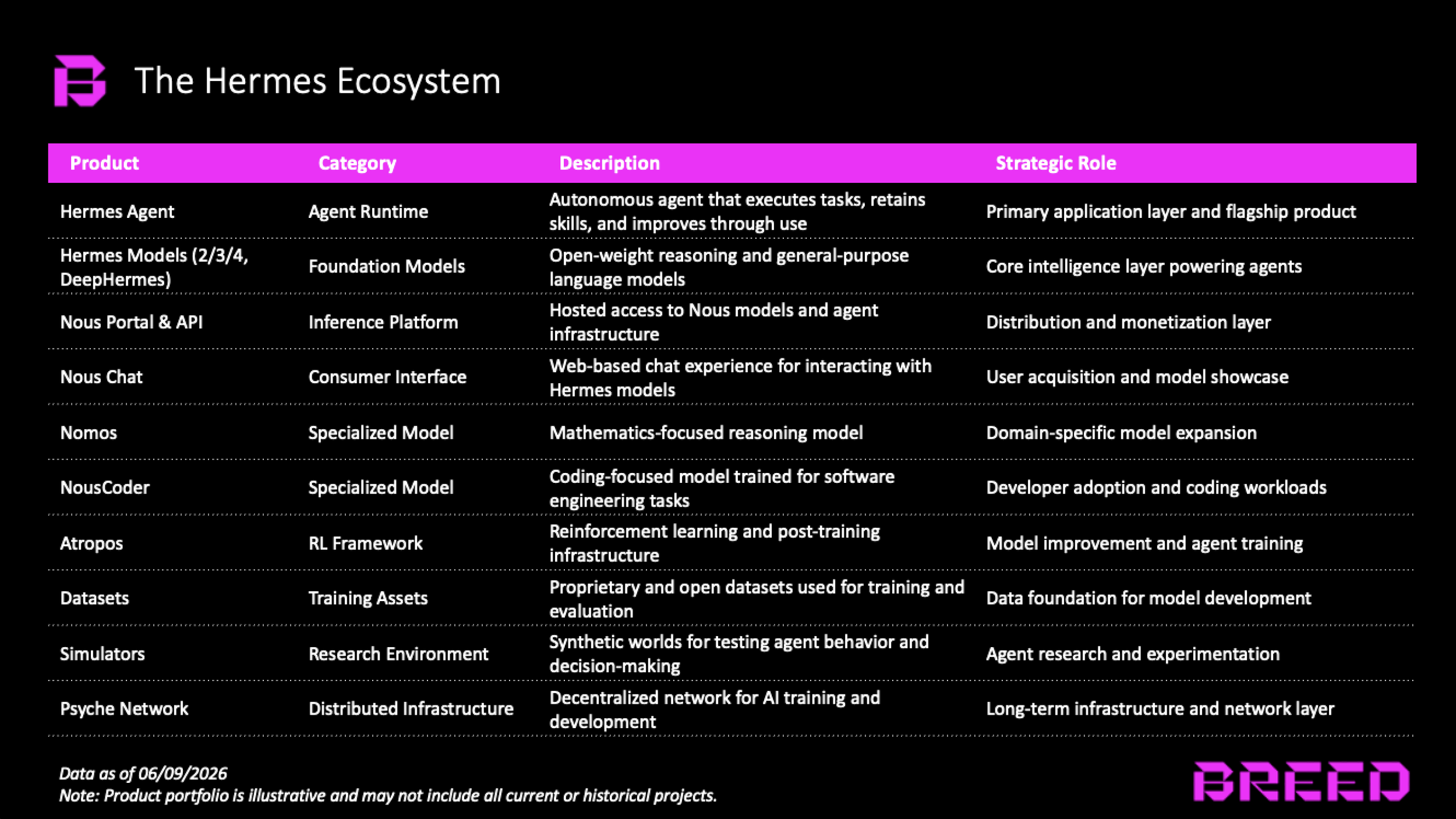
Hermes is Nous Research's flagship family of models and agent infrastructure. Initially launched as an instruction-tuned model built on top of open-source foundations, Hermes quickly gained a reputation for strong reasoning, coding ability, instruction following, and tool usage.
At a high level, Hermes takes powerful open-source base models and fine-tunes them for agentic workflows. The result is a system optimized for long-context reasoning, multi-step planning, structured outputs, tool usage, and autonomous task execution.
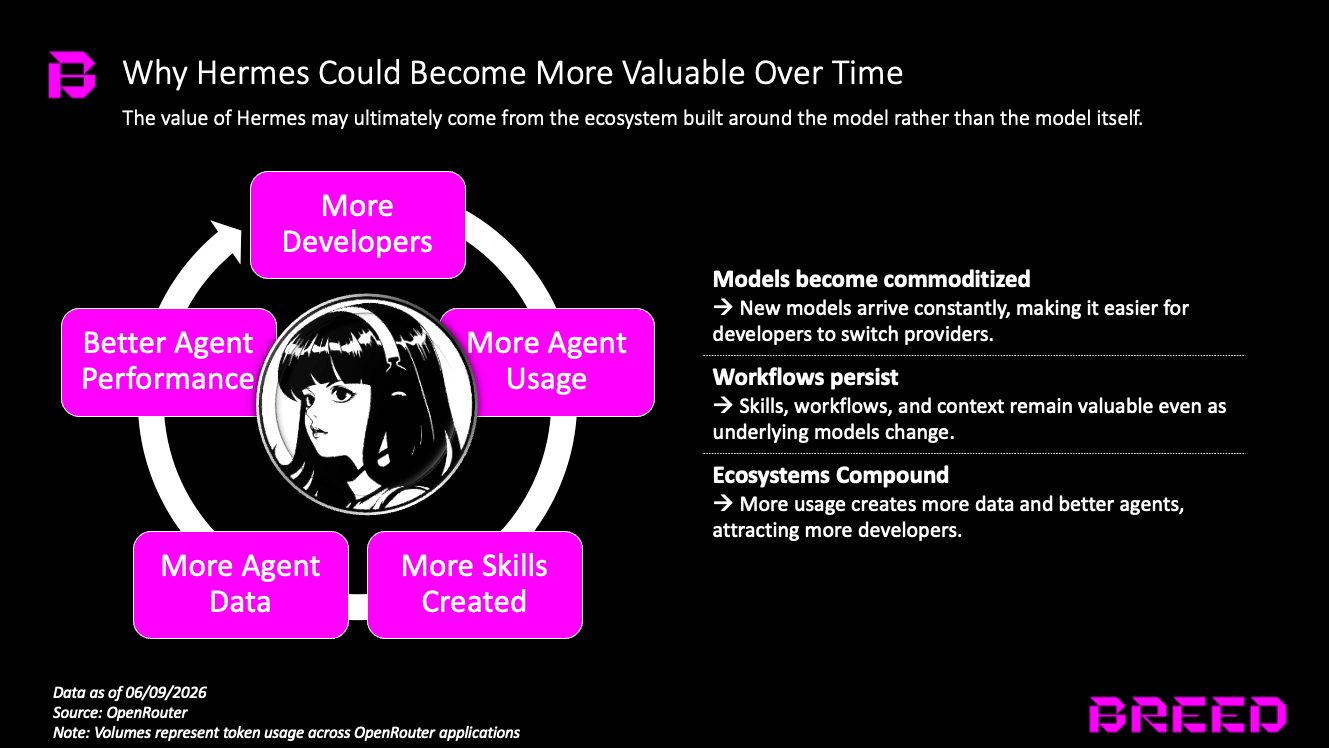
Hermes sits in a unique position in the AI stack. Rather than competing directly as a model provider, Hermes sits above the models themselves, allowing developers to use whichever underlying models perform best. As new models emerge, developers can switch providers without abandoning the workflows, skills, and infrastructure they have already built.
The significance of Hermes is that it helped bridge the gap between general-purpose LLMs and autonomous agents. As a result, Hermes became highly attractive to developers building AI coworkers, research agents, coding agents, autonomous browsers, trading systems, DeFi agents, AI NPCs, and multi-agent architectures.
What makes Hermes particularly interesting is that it is designed to improve over time. Every session a Hermes Agent runs generates information that can be used in future sessions. For example, if a task requires multiple tool calls, Hermes can automatically create reusable skill files following the Agent Skills open standard.
Over time, these skills compound, allowing agents to become more capable and efficient as they accumulate experience.
Hermes Traction And Adoption
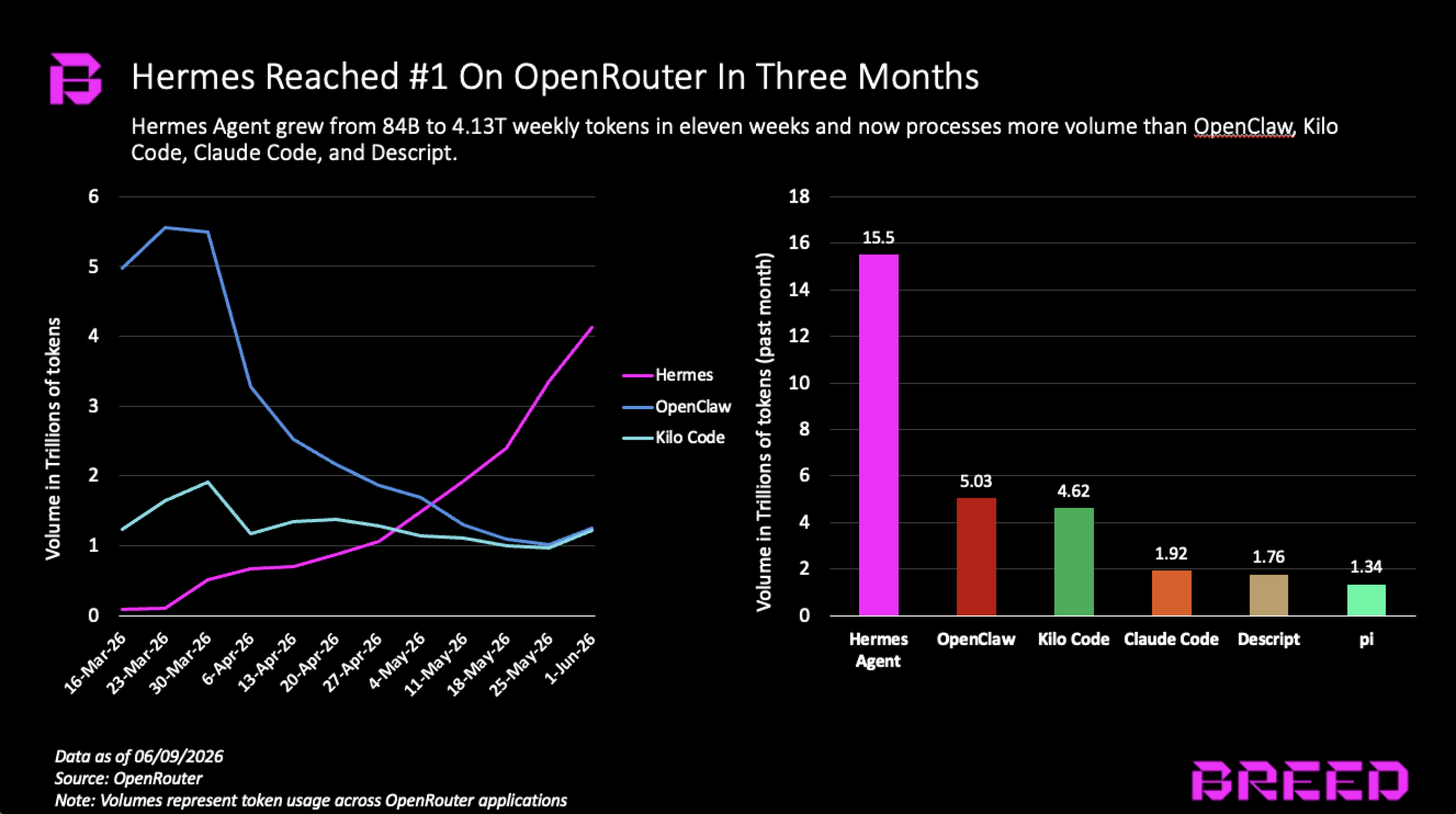
Hermes has taken over
In March 2026, years of model development, fine-tuning, and reinforcement learning research culminated in the launch of Hermes Agent.
The launch could not have come at a better time. Developers were increasingly moving beyond chatbots and beginning to build autonomous agents executing complex workflows on behalf of users.
Within weeks of launch, Hermes Agent climbed to the top of OpenRouter, becoming the platform's highest-volume application by token usage. Today, Hermes routes more volume than OpenClaw, Kilo Code, Claude Code, and Descript, processing trillions of tokens every week across a wide range of models and workflows.
The speed of this growth is particularly notable given the level of competition. The agent ecosystem has become one of the most crowded markets in AI, with new products launching almost daily. Despite this, Hermes rapidly emerged as one of the most widely used agent frameworks in the industry.
Why Hermes Matters
The most interesting thing about Hermes is that its value extends beyond the underlying model.
The AI industry moves incredibly fast with new models released almost weekly, each claiming better reasoning, larger context windows, or superior performance. Developers naturally gravitate toward whichever models provide the best capabilities at the lowest cost.
This creates a difficult problem for AI companies. If better models are constantly emerging, what keeps users coming back? For Hermes, the answer is everything built around the model.
Every time a developer uses Hermes, they create workflows, skills, and context that can be reused in future sessions. Over time, these assets compound, making the system increasingly useful.
This is one of the reasons Hermes' recent growth is so important. The more developers building on top of the platform, the more workflows, skills, and real-world usage data the ecosystem accumulates.
Additionally, every interaction with Hermes generates valuable behavioral data. Over time, this data can improve the underlying models themselves. It is not unreasonable to believe that Hermes could eventually help develop one of the most powerful open-source models in the world.
Where We Go From Here
Today, Nous has become one of the most important organizations in AI and Hermes has emerged as one of the fastest-growing agent frameworks in the industry.
The next phase of AI will likely be defined by agents. These systems will conduct research, write code, manage workflows, and increasingly perform work on behalf of users.
If that future materializes, demand for open, customizable, and developer-friendly agent infrastructure will grow dramatically.
If agents become a meaningful part of how software is built and digital work is performed, there is a good chance that the next generation of developers will build on Hermes.